Tetsuo Harada - Sculpturing for Peace
Tetsuo Harada is a Japanese-French sculptor whose monumental stone works speak quietly yet powerfully of peace. Living between Japan and France, his art flows between cultures, shaped by nature, memory, and human connection. Through his lifelong dedication to Art for Peace, Harada creates sculptures that stand as silent witnesses to reconciliation, inviting reflection, presence, and hope in public spaces around the world.
In this conversation, Annie Harada and Seth Kinzie come together to explore the deep relationship between peace and art. We reflect on why peace is not something distant or abstract, but something that needs to be present in every aspect of our daily lives — in how we create, how we listen, and how we relate to one another. Art plays a powerful role in this process. Throughout the talk, we discuss how artistic expression can become a space for presence, healing, and dialogue, and how it can gently invite peace into the world.

English: THE 38th PARALLEL
Kajigawa, Niigata, Japan. Sculpture environment for Peace on the concept of a Tricot Earth. "38th Parallel" is a pink granite of Clarity, H 400, paving: 570 x 500, sphére 120, axis of 20 meters long, 40 tons of granite. The city of Kajigawa, Japan, is located on the 38th parallel (latitude). This line separates North Korea from South Korea.Tetsuo Harada sculpts this sculpture for peace and reconciliation between the two Korea. The two blocks of the pyramid meet exactly at the 38th parallel and are united by a spère. The Tricot the Earth, carrying peace and union, is also present in this sculpture. As Tetsuo Harada, the city of Kajigawa and the Ministry of Public Works who commissioned the sculpture, wish to convey this message of peace. They invite other cities in the world located on the 38th parallel to express that hope by culture, art or sport.The city of Athens, also located on the 38th parallel, has adopted the theme "38th parallel horizon" for the artistic and cultural Olympics of 2004.
The 38th through: Italy, Spain, Portugal, Turkey, Iran, Turkmenistan, Tajikistan, China, Korea, Japan, California, Utah, Colorado, Kansas, Indiana, Kentucky, Virginia.
Français : LE 38ème PARALLÈLE est une sculpture monumentale réalisée par le sculpteur Tetsuo Harada. Inaugurée en 1992. Il a 44 ans.
Kajigawa, Niigata, Japon. Sculpture environnement pour la Paix sur le concept du Tricot de a Terre. «38e Parallèle» est en granit rose de la Clarté, H 400, dallage : 570 x 500, sphére 120, axe de 20 mètres de long, 40 tonnes de granit. La ville de Kajigawa, au Japon, est située sur le 38ème parallèle (latitude). Cette ligne sépare la Corée du Nord de la Corée du Sud. Tetsuo Harada sculpte cette sculpture pour la paix et la réconciliation entre les deux Corée. Les deux blocs de la pyramide se rejoignent exactement au niveau du 38ème parallèle et sont unis par une spère. Le Tricot de la Terre, porteur de paix et d’union, est également présent dans cette sculpture. Comme Tetsuo Harada, la ville de Kajigawa et le Ministère de l’Equipement qui ont commandé cette sculpture, souhaitent exprimer ce message de paix. Ils invitent les autres villes du monde situées également sur le 38ème parallèle à exprimer cet espoir par la culture, l'art ou le sport. La ville d’Athènes, également située sur le 38ème parallèle, a adopté ce thème “38ème parallèle, horizon” pour le programme artistique et culturel des Jeux olympiques de 2004.
Le 38ème traverse : Italie, Espagne, Portugal, Turquie, Iran, Turkmenistan, Tajikistan, Chine, Corée, Japon, Californie, Utah, Colorado, Kansas, Indiana, Kentucky, Virginia.
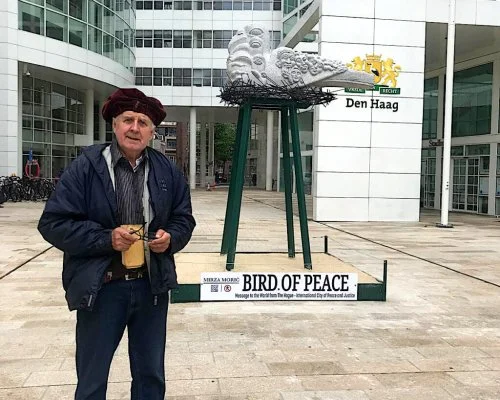
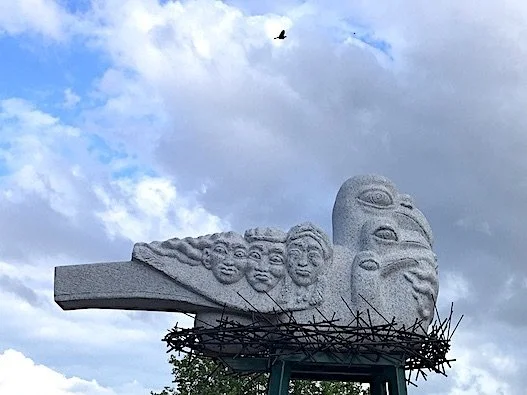
‘The Bird of Peace’ sculpture by Mirza Morić
The Bird of Peace by Mirza Morić is more than a sculpture—it feels like a quiet meditation carved into stone. Born in Bosnia and Herzegovina, Morić grew up surrounded by layered histories, cultures, and identities. In 1977, he moved to France in search of artistic growth—a place where he could shape his voice and deepen his craft.
Over time, his life bridged different worlds. When war later touched his homeland in the 1990s, those distant events gave new weight to his work. Memory, loss, and the fragility of peace became more than abstract ideas—they became deeply personal reflections carried across borders.
Morić works with stone as if it were alive—solid, enduring, yet capable of tenderness. Again and again, he turns to the image of the bird: a timeless symbol of freedom, of movement, of the soul rising beyond division.
In The Bird of Peace, a bird gathers strength before flight. Faces carved into its wings—women, children, thinkers—emerge like echoes of humanity itself. They speak of suffering, but also of wisdom and quiet resilience. The sculpture does not deny pain; it holds it, and then gently lifts it upward.
Morić’s message is subtle but powerful: peace is not something distant or abstract. It is something we shape—patiently, consciously—just as he shapes stone, giving form to hope.